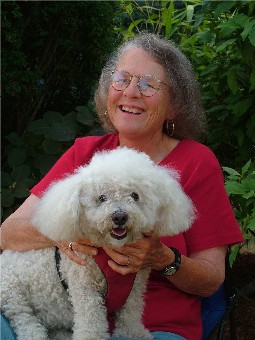
We’re supposed to be enjoying ourselves. People on the right are often filled with hate, but those of us on the left are angry or self-righteous a lot of the time. The best way to draw people into our movement is to welcome people and help them enjoy themselves. One of our longtime progressives, Barbara Ehrenreich, reminds us of that in her new book, Dancing in the Streets: A History of Collective Joy.
She shows how essential collective joy is to us, as human beings, and how dancing always threatens those in power. Where are our liberal dances! Bring back rock and roll parties. Let’s scare the people in charge!
Catch Barbara's message in a New York Times piece.
Showing posts with label slow lifestyles. Show all posts
Showing posts with label slow lifestyles. Show all posts
Wednesday, June 06, 2007


Saturday, May 26, 2007
Hi, I'm Joan and I'm a Workaholic
What do we do about our extreme working hours? Everything suffers: our health, our relationships, our civic engagement, our creativity, and even, eventually, the workplace. Americans have much worse health that Europeans and that brings absenteeism, turnover, and more mistakes to our workplaces. And what happens to kids?
How can Americans learn to think in terms of the long run instead of short term results?
Some of the people working 16 hour days claim they love it. But how long can they keep it up before they fall apart?
We need policies that give people shorter work hours, but this won’t happen until people demand it. Americans still don’t realize how important it is to have balance in life. We need a movement for a healthier work place. The Take Back Your Time movement is working for this.
Some people are starting to understand and have joined “workaholics anonymous.” Maybe the only way we can change is to join with others and tell our stories and to begin to gain strength from each other.
Tuesday, January 30, 2007
Bichons Against Bush! Slow Protests against the War
My husband Paul took some video at our Seattle peace march Saturday, focusing on our bichon Maggie and her new friend Whistler! along with our friends in the Phinney Neighbors for Peace and Justice.
It was a "Slow March!" Central to the Slow life are community, leisure, and joie de vivre. Most people don't expect that you can experience these things at a protest march, but this video shows that that's exactly what you can do. It was not a grim affair, notice all the poochies for peace and smiling faces. There was a lot of hope, even in the face of an unyielding administration.
To my mind this video captures the event better than any of the news stories, with their disinterested (and uninteresting) focus on police control and headcounts. In their efforts to be unbiased or objective or whatever term they want to apply, mainstream journalists also become dessicated stenographers of meaningless factoids, "reporting" but not thinking or actively writing. If they're as bored with their jobs as their dispatches make them appear, they should find a line of work that inspires and invigorates them — and leave real journalism to people who care about the truth, humanity and justice.
Slow Life Slow Food voluntary simplicity Cecile Andrews Take Back Your Time green lifestyle Slow Is Beautiful simple living ecovillage phinney ecovillage
Thursday, January 25, 2007
Little Miss Sunshine and the Slow Life's values

I was pleased to see that Little Miss Sunshine has been nominated for best picture for the Oscars. It certainly carries the “slow” theme -- it’s a questioning of “success” as we’ve come to think of it. Being a winner of some sort, any sort. The dad wants to be a winner at the “motivational speakers” game and the daughter wants to win a beauty pageant. As the son says when he realizes that his dream of success is impossible, “Life is just a series of beauty pageants.” Yes indeed. We’re judged all of the time and almost always for putting on a false front, pretending that we’re something that we’re not. We’re always on show, always being judged by our appearances, rarely getting to be ourselves.
Little Miss Sunshine is in the tradition of two of my other favorite movies: Zorba the Greek and Harold and Maude. They’re all about “the great escape,” about narrowly missing getting what you thought you wanted, and finding that “failure” was better. They’re all about seeing through the conventional culture and coming to embrace the “counter” culture that rejects success as measured in wealth or status. In each movie there is a disturbing character that makes the main character question the status quo. For the young Englishman, it’s obviously Zorba. For Harold, it’s Maude. For the family of Little Miss Sunshine, it’s the outrageous grandfather played by Alan Arkin. In each one, there is a triumphant escape from becoming a success in the traditional sense.
But even though I really loved Little Miss Sunshine, I don’t think it can measure up to the other two. They each had a vision of life that involved a sense of something sublime and wonderful. Not so for Little Miss Sunshine. I think it’s a measure that our sense of what is possible in life has been diminished. However, maybe Little Miss Sunshine has something the others don’t. It affirms that the most important thing is your relationships. In the end only this movie has that theme.
It’s a wonderful movie and one we should remember when we begin to yearn for the “success” that we’ve been conditioned to want.
Monday, January 15, 2007
Wal-Mart's Evil Plan to Put Employees on Call
Happiness research shows that it is important for people to have control over their lives, and I spend considerable space in Slow Is Beautiful getting at the true nature of happiness (hint: it's not making more money!).
Yet getting control over your life is not only hard in the corporate consumer culture that uses every waking moment to try to sell you stuff you don't need, now corporations may be robbing you of the very ability to control your existence.
Take this new Wal-Mart idea: Wal-Mart's software allows it to schedule people to work when the crowds are there and cut back when the store is slow. "
But while the new systems are expected to benefit both retailers and customers, some experts say they can saddle workers with unpredictable schedules. In some cases, they may be asked to be "on call" to meet customer surges, or sent home because of a lull, resulting in less pay.
The new systems also alert managers when a worker is approaching full-time status or overtime, which would require higher wages and benefits, so they can scale back that person's schedule.That means workers may not know when or if they will need a babysitter or whether they will work enough hours to pay that month's bills. Rather than work three eight-hour days, someone might now be plugged into six four-hour days, mornings one week and evenings the next.Some analysts say the new systems will result in more irregular part-time work.
"The whole point is workers were a fixed cost, now they're a variable cost. Is it good for workers? Probably not," says Kenneth Dalto, a management consultant in Farmington Hills, Mich. ..."
Another evil idea from Wal-Mart, and guess what: The stock went up!
Full story from the Los Angeles Times:
Wal-Mart Stores Inc., the largest private U.S. employer, is rolling out software that will allow the company to schedule workers based on the number of customers in stores.
Wal-Mart began testing the software last year and plans to install it in all U.S. stores sometime next year, spokeswoman Sarah Clark said Wednesday. All cashiers and customer service employees already use the system, she said.
The software assigns employees based on customer traffic rather than on a store's sales, as was the case in the past, allowing the company to meet demand at peak times.
Groups such as Wake-Up Wal-Mart and Wal-Mart Watch, which have lobbied the company to raise pay and benefits, have criticized the new method, saying it subjects workers to potentially fewer hours.
"Retailers as a whole are embracing technology," said Rick Rubin, an analyst at Mercantile Bankshares Corp. in Baltimore. "It's probably the right decision from a customer-service standpoint. It may not make employees all that happy."
Clark said enough employees such as senior citizens and students were available to work late and weekend hours.
"The company has not asked any associate to change their availability as a result of this system," she said. About three-quarters of Wal-Mart's 1.3 million U.S. workers are full-time, Clark said.
Robert Angelo, director of the Rutgers Union Leadership Academy, part of the university's School of Management and Labor Relations in New Brunswick, N.J., said he questioned whether Wal-Mart's changes would benefit workers, "given their track record."
"In some cases, flexible hours means less hours," he said.
Improving customer service isn't just about adding workers at busy times, Angelo said. It's also means ensuring that people are working productively.
"This is one piece of a deliberate effort to cut benefit costs through more part-time employees," said Nu Wexler, communications director at Wal-Mart Watch, which is a Washington-based coalition of labor, religious, community and environmental groups. The rollout was previously reported by the Wall Street Journal.
Shares of Bentonville, Ark.-based Wal-Mart rose $1.37, or 3%, to $47.55.
Slow Life Slow Food voluntary simplicity Cecile Andrews Take Back Your Time green lifestyle Slow Is Beautiful simple living ecovillage phinney ecovillage
Wednesday, December 13, 2006
Richest 2 percent hold half world's assets
Common Dreams: "Personal wealth is distributed so unevenly across the world that the richest two per cent of adults own more than 50 per cent of the world’s assets while the poorest half hold only 1 per cent of wealth."
Understanding the gap between the rich and the rest of us is crucial to understanding why we are unhappy, unhealthy and bent on ecological self-destruction. In Slow Is Beautiful I talk about how the gap is the biggest indicator of the health of a nation. In the 1950s when the gap was smallest in the U.S., we led the world in healthiness. Today, with the gap the widest, we're dead last (pun unintended but acknowledged) among industrialized nations. Our life expectancy also is on the verge of falling. Next time you're in the market or a store, check out the condition of folks around you. Sometimes it seems we're walking around in a hospital emergency ward.
Slowing down is one of the few natural defenses we have against the ravages of consumerism and greed, but it takes conscious planning and persistence to accomplish. Put it on your New Year's Resolution list, in fact, don't even have a list. Just write "Slow Is Beautiful" at the top and look at it every day!
Slow Life Slow Food voluntary simplicity Cecile Andrews Take Back Your Time green lifestyle Slow Is Beautiful simple living ecovillage phinney ecovillage
Holiday Consumerism Brings Little Joy
David Horsey (in Seattle Post-Intelligencer):
"Still, Bothell resident Susan Lamb Virant said consumerism, in moderation, can be a joyous experience, but she added this sobering thought: 'This may be my last Christmas season, as I have terminal cancer. I would never waste this precious time on bargain-shopping mania. Perhaps we all (including those merchants who offer the 'doorbusters') should plan each holiday as though it were our last, remembering why we are celebrating, treating one another with kindness and feeling joy just to be alive and well -- well enough to shop'!"
If there's one lesson to Slow Is Beautiful, it's that we need to treat each moment as though it could be our last. Would you want your final hours to be spent standing in line at a mall?
Slow Life Slow Food voluntary simplicity Cecile Andrews Take Back Your Time green lifestyle Slow Is Beautiful simple living ecovillage phinney ecovillage
Subscribe to:
Posts (Atom)